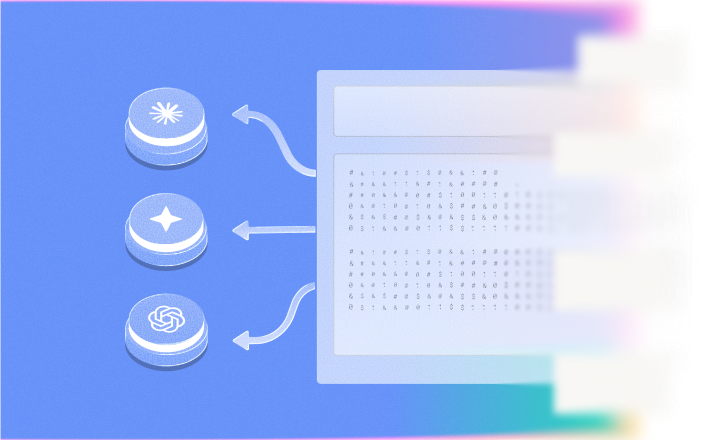
Platform engineering

One platform for every AI use case you put live

We build the platform your AI runs on: governed landing zones, LLMOps pipelines, one AI gateway and inference tuned for latency and cost.

The problem

Your teams keep proving AI works. None of it reaches production.

Every pilot your teams build hits the same wall before production.

  1. Your teams run dozens of GenAI pilots, each with its own way in to the models and no governed entry point.

  2. Prompts are edited directly in production, with no versioned release, no eval gate and no way to roll back.

  3. Your assistant answers at production volume, and nobody can say what each answer costs.

  4. Data that cannot leave your VPC keeps the use cases that matter most stuck in security review.

Why a platform

You are right to want a platform before the tenth use case, not after it.

Your teams’ time Run by devx
Product development

TodayShadow AI: keys in notebooks, no inventory of who calls which model

With devxOne AI gateway: every model call authenticated, logged, metered and routed by policy

TodayModels shipped by hand, prompts edited in production

With devxVersioned prompts, models and retrievers, with eval gates in CI/CD, canary releases and one-click rollback

TodayNo one knows the cost per request; GPU capacity bought on hope

With devxCost to serve per use case, token budgets per team, and routing that sends simple work to smaller models

TodaySecurity reviews that hold launches for months

With devxPre-approved patterns for private networking, encryption keys, data residency and policy-as-code, so reviews take days

What we build

Six pieces, one platform.

AI Landing Zone

The secure ground floor for every AI workload.

A multi-account foundation built as code, with identity, network isolation and data residency in place before the first model call.

  • Terraform blueprints for Google Cloud and AWS
  • Private endpoints, VPC Service Controls and PrivateLink, customer-managed keys
  • Organisation policies and guardrails as code
  • Residency patterns for India and Singapore workloads
AI Gateway and Model Routing

One door for every model.

A control point between your applications and every model provider for authentication, quotas, routing, fallback and logging.

  • Routing across Gemini, Claude, GPT and open-weight models
  • Semantic caching, rate limits and per-team token budgets
  • PII redaction and full prompt and response logging
  • Failover across regions and providers
LLMOps and MLOps Pipelines

Ship models and prompts the way you ship software.

Release discipline for everything that changes model behaviour.

  • One registry for models, prompts, embeddings and retrievers
  • Eval gates in CI/CD, run with the Assurance practice
  • Canary, shadow and A/B releases
  • Experiment tracking, feature store integration and drift monitors
Inference Engineering

Fast enough for the use case, cheap enough for the P&L.

Serving designed around a latency budget and a cost target for each use case.

  • Serving on Vertex AI, Amazon Bedrock, GKE or EKS with vLLM
  • GPU and TPU right-sizing, autoscaling, batching and quantisation
  • Separate budgets for real-time voice, interactive chat and batch work
  • Distilled or fine-tuned small models where they match quality at lower cost
AI FinOps and Observability

Know what every answer costs.

The numbers that let finance and engineering have the same conversation.

  • Cost per request, per user and per use case
  • OpenTelemetry tracing across gateway, retrieval, model and tools
  • SLOs for latency, error rate and availability
  • Capacity planning and committed-use strategy
AI Developer Platform

Golden paths, so teams build fast without rebuilding the stack.

Self-service for product teams, with the guardrails already inside.

  • Templates for RAG, agent and batch workloads
  • An internal developer portal for discovery and onboarding
  • Sandboxes with synthetic data
  • Self-service access to the gateway with approved models
How we work

We build inside the cloud you already run.
No rip-and-replace.

The target design grows from what already runs, with a deliverable at the end of every phase.

  1. Assess · Weeks 1–2

    You get AI platform scorecard, cost baseline, risk register

    Inventory every model, key, data flow and spend line.

  2. Architect · Weeks 2–4

    You get Reference architecture, IaC repository, gateway design

    Target design and guardrails agreed with security and finance.

  3. Build · Weeks 4–10

    You get Running platform and runbooks

    Landing zone, gateway and first pipeline live; first two use cases onboarded.

  4. Run and optimise · Week 10 onward

    You get Monthly cost-to-serve report

    Monthly cost and SLO reviews; handover or managed run.

6 weeks

Second use case live

Larkspur Insurance
−31%

Cost per completed task

Corvane Bank
82%

Accepted without edits

Halden Health
Use cases

Use cases and the outcomes they change.

01 / 10

Enterprise AI gateway rollout

Bank or insurer with dozens of GenAI pilots
What changesAll model traffic passes through one governed entry point
Outcome it moves
Share of AI traffic governedTime to approve a new use case
02 / 10

GenAI landing zone for regulated data

Financial services, healthcare, public sector
What changesA reference architecture security has already approved
Outcome it moves
Security review timeAudit findings
03 / 10

Cost-to-serve reduction for a live assistant

Service assistant at production volume
What changesCaching, routing and smaller models for simple intents
Outcome it moves
Cost per conversationp95 latency
04 / 10

Open-weight models in your own tenancy

Data that cannot leave the VPC
What changesGemma, Llama or Mistral served on your GPUs
Outcome it moves
Residency complianceCost per million tokens
05 / 10

Prompt and model release pipeline

Teams editing prompts directly in production
What changesVersioned releases with eval gates and rollback
Outcome it moves
Change failure rateTime to roll back
06 / 10

Multi-region AI failover

Contact centre and operations-critical copilots
What changesAutomatic failover across providers and regions
Outcome it moves
Availability against SLO
07 / 10

Model and cloud portability

New model generation, contract change, merger
What changesGateway abstraction and infrastructure as code
Outcome it moves
Migration timeRegressions after cutover
08 / 10

ML platform modernisation

On-premises Spark or Hadoop machine learning
What changesManaged training, registry and serving
Outcome it moves
Model deployment frequencyInfrastructure cost
09 / 10

GPU capacity planning

Fine-tuning and large batch inference
What changesRight-sized clusters and a spot or preemptible strategy
Outcome it moves
GPU utilisationCompute spend
10 / 10

Golden paths for product teams

Ten or more teams building with AI
What changesTemplates and self-service onboarding
Outcome it moves
Lead time from idea to first production release

Our fees move with these numbers.

Four numbers, agreed in week two against your own telemetry.

Questions

Ask us anything.

Ask devx › Questions buyers ask
Enter ↵
h1 · cooper light

Bring us your messiest AI estate.

In two weeks you get a platform scorecard, a cost-to-serve baseline and the three changes that matter most.